
The Edmonton LRT: lines, stations, fares and times
Three colour-coded lines, a flat $3 fare and every station step-free. Everything here is built from Edmonton Transit Service's own published schedule data — and kept plain about how the network really works.
3
colour-coded lines
29
stations
1978
first line opened
$3.00
flat fare, any distance
New to the Edmonton LRT?
Edmonton’s light rail transit — the LRT — is part of Edmonton Transit Service (ETS). The Capital Line opened in 1978, widely credited as the first modern light rail line in North America built by a city of under a million people, and the network has grown to 3 lines and 29 stations reaching from the northeast right across the river valley to the south and southeast.
A few things are worth knowing before your first trip:
- Three colour-coded lines. The Capital Line (blue) and the Metro Line (red) are high-floor trains that share the same downtown tunnel; the Valley Line (green) is a separate, modern low-floor line that runs at street level like a tram.
- One flat fare. $3.00 takes you anywhere on the network — one stop or the full length of a line. There are no zones and no distance bands, and one fare buys 90 minutes of travel including transfers to buses.
- Fare capping instead of passes. Tap the same bank card, phone or Arc card on the way in and again on the way out; once your taps reach the $10.50 daily cap you are not charged again that day, so most riders never need to buy a pass.
The three lines
Tap a line for its full station list, how often trains run and the first and last train from every stop.

Capital Line
Clareview ↔ Century Park

Metro Line
Health Sciences/Jubilee ↔ NAIT/Blatchford Market

Valley Line
Mill Woods ↔ 102 Street
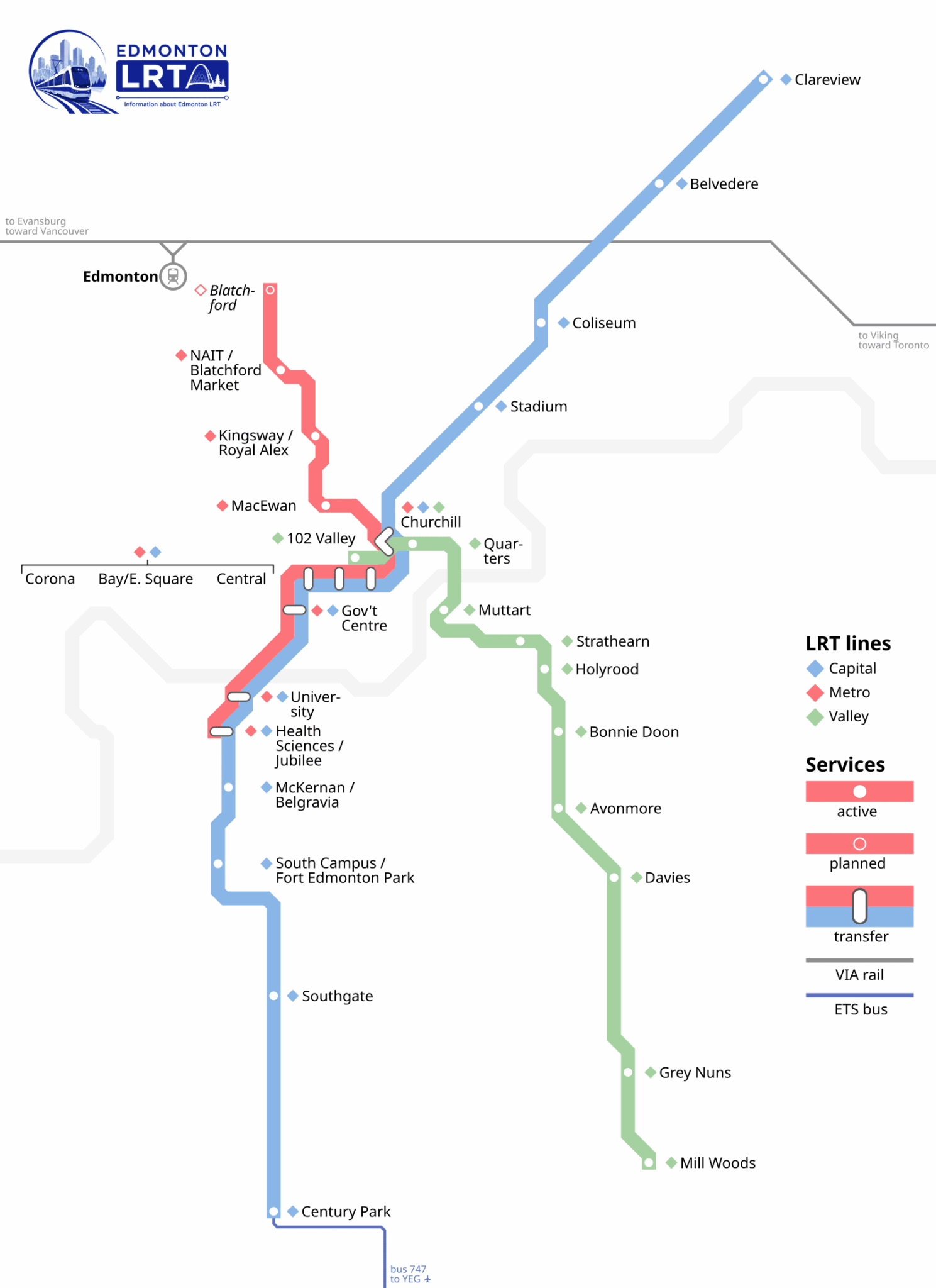
The Edmonton LRT map
The whole network on one diagram. Download it as a PDF and it will still be readable when your phone has no signal in the tunnel.
Service status
Edmonton LRT status
Service status · based on the published timetable
Clareview ↔ Century Park
Health Sciences/Jubilee ↔ NAIT/Blatchford Market
Mill Woods ↔ 102 Street
Work out any journey on the network
Pick two stations and the planner gives you the time, the stops, the changes and what it costs — using the ETS schedule, so it knows how often each line runs and that the Valley Line connects to the rest of the network only by a short walk at Churchill.
What it costs
| Fare | Price | Notes |
|---|---|---|
| Single ride, Arc card | $3.00 | One 90-minute journey, transfers included |
| Single ride, tap to pay | $3.00 | Contactless bank card or phone — nothing to buy |
| Cash on a bus, or 90-minute Arc ticket | $3.75 | Exact cash on buses; Arc tickets from the fare vending machines at every LRT station (cash, debit or credit) |
| 24-hour Arc ticket | $10.50 | Unlimited rides for 24 hours from the first tap; sold at LRT station vending machines |
| Route 747 airport bus | $6.00 | One way to Edmonton International Airport; its own fare, no transfer included |
| Transfer | Free | Keep riding for 90 minutes on the same fare (bus ↔ LRT) |
| Cap | Amount | What it does |
|---|---|---|
| Daily cap | $10.50 | Tap the same card all day; you are never charged past this. It works like a day pass |
| Adult monthly cap | $102.00 | A month of rides once your taps reach this total |
| Youth monthly cap | $66.00 | Ages 18 and under, with the youth concession on your Arc account |
| Senior monthly cap | $36.00 | Ages 65+, with the senior concession on your Arc account |
| Child 12 & under | Free | Free with a fare-paying rider |
Fares from ETS (edmonton.ca/ets). Edmonton uses fare capping — tap and you are never charged past the daily or monthly cap.
Popular trips
Across the Capital Line
Clareview → Century Park
Metro Line end to end
NAIT/Blatchford Market → Health Sciences/Jubilee
Valley Line into downtown
Mill Woods → Churchill
Northeast to NAIT
Clareview → NAIT/Blatchford Market
South to campus
Century Park → University
Southeast to south side
Mill Woods → Century Park
Common questions
$3.00 for any journey, however far you go — one stop or the full length of a line. There are no zones: the same flat fare covers the whole network. One fare also gives you a 90-minute transfer window, so you can change trains, or hop on a bus, at no extra cost within that time.
Edmonton uses fare capping instead of passes. Keep tapping the same card — an Arc card or a contactless bank card or phone — and you are never charged past the $10.50 daily cap or the $102.00 monthly cap, which is why the old paper day and monthly passes are gone. Remember to tap on when you enter and tap off when you leave. See fares in full.
No — no line runs overnight. All three lines run roughly 5 am to 1 am every day. After the LRT closes, ETS runs OWL night buses until around 3 am on the busiest corridors.
Our schedule page lists the first and last train at every stop, which shift a little from one end of a line to the other.
You can’t ride the LRT the whole way — Edmonton International Airport (YEG) is well south of the city and is not on the rail network. Instead, take the Capital Line south to Century Park and change there for the Route 747 bus, which runs straight to the airport terminal. The 747 has its own fare — $6 one way (cash, Arc ticket or tap), with no transfer included — and the regular 3- and 5-day passes are not valid on it.
Plan the trip to Century Park, then catch the 747 from the transit centre next to the station.
You don’t need to buy anything to ride. You have two easy options:
- Just tap a contactless bank card or phone at the reader. Same $3.00 fare, nothing to set up — this is the simplest choice for visitors.
- An Arc card — Edmonton’s reloadable regional tap card. A bank card tapped consistently already gets the standard adult daily and monthly caps; an Arc card is what you need for concession fares (youth, senior, low income). Reload it at myarc.ca, on the Arc app or by phone; the balance is held in a secure online account, so registering protects it if the card is lost.
Yes — every Edmonton LRT station is step-free, with elevators or ramps and level boarding onto the trains. All 29 stations are accessible, so you can roll straight on with a wheelchair, walker or stroller.
Every train has priority seating and dedicated space for wheelchairs, and the low-floor Valley Line trams board level with the platform edge.
Through downtown the Capital and Metro lines run on the same tracks and stop at the same platforms — the shared trunk from Health Sciences/Jubilee up to Churchill. On any of those stations you can board whichever line comes first if it is heading your way.
North of Churchill they split: the Capital Line carries on northeast to Clareview, while the Metro Line branches northwest to NAIT/Blatchford Market. The Valley Line is separate and meets the two only by a short walk at Churchill.